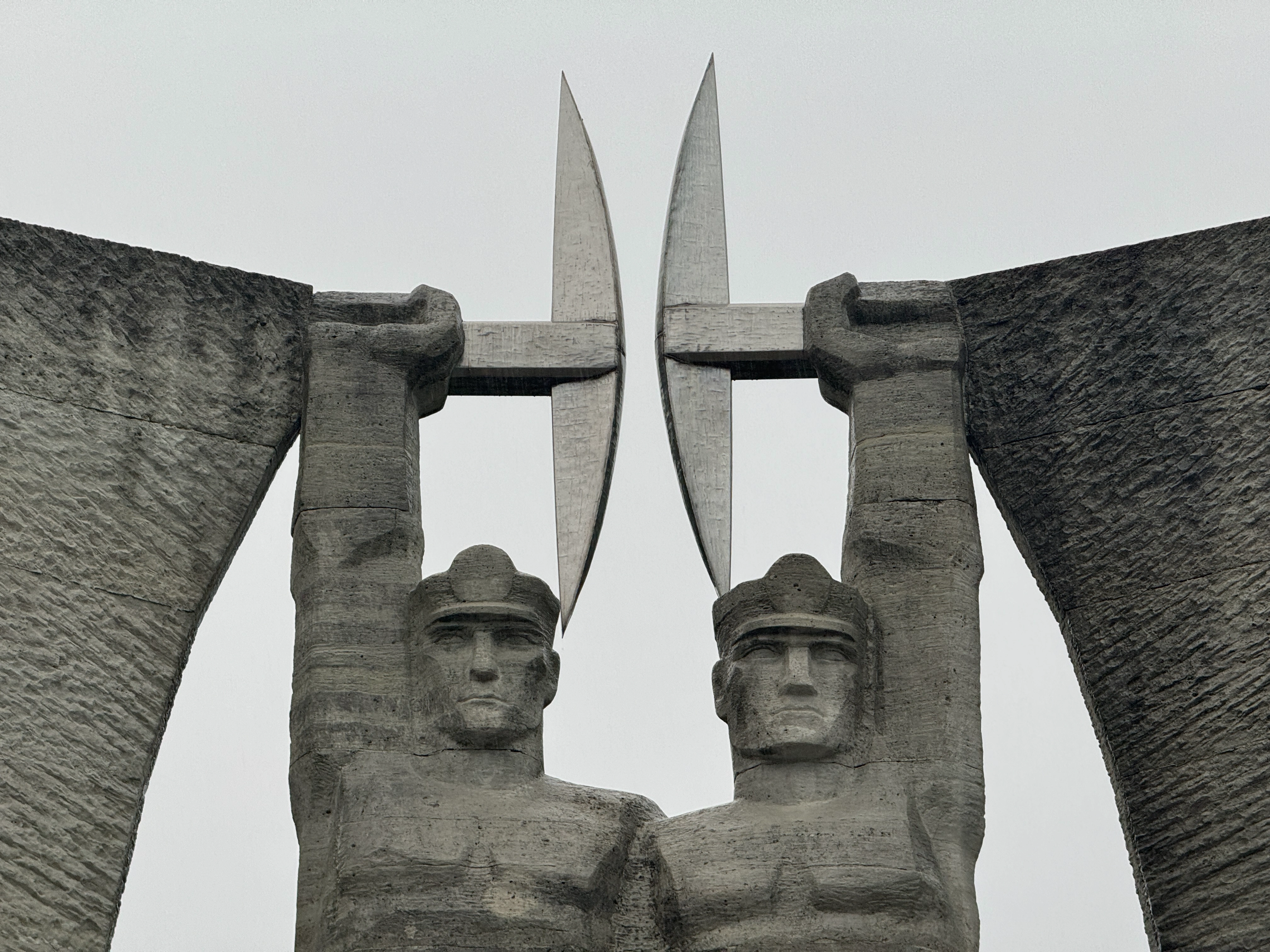
In November 1967, the monument Glory to Work was unveiled in Kohtla-Järve's Järve district, which was then known as the Socialist district. Designed by sculptor Olav Männi and architect Udo Ivask, the over 10-meter-high dolomite and concrete monument depicts two vigorous miners with stern faces holding their metal pickaxes high. It was built to honor the oil shale miners who formed the backbone of this Soviet industrial town. Originally planned to be named "Shoulder Beside Shoulder", the local party committee renamed it "Glory to Work". The monument stood by a tribune where party functionaries reviewed parades and waved at workers. In 1971, a time capsule with a message for the residents of 2046 was embedded in the base, though it was recovered and moved to the Oil Shale Museum when the tribune was altered in the 1990s.
Despite its official, slogan-like name, the local population quickly and affectionately dubbed the monument "Two Sober Miners" or simply "Two Sobers", joking that they were the only miners in Kohtla-Järve who stayed sober after payday. Other popular nicknames included "The Žiljabin Brothers" and "Väino and Jaan". Over the years, the monument underwent several changes. In 1996, the tribune in front of it was reduced by a third. In 2020, the monument's base and stairs were thoroughly restored for nearly 21,000 euros, and the concrete miners were washed. Today, it remains one of the most prominent visual symbols of Kohtla-Järve.
The monument is located at Peace Square near Keskallee park in the center of Kohtla-Järve. As a public monument, it is freely accessible and can be viewed at any time from the street or the surrounding square.