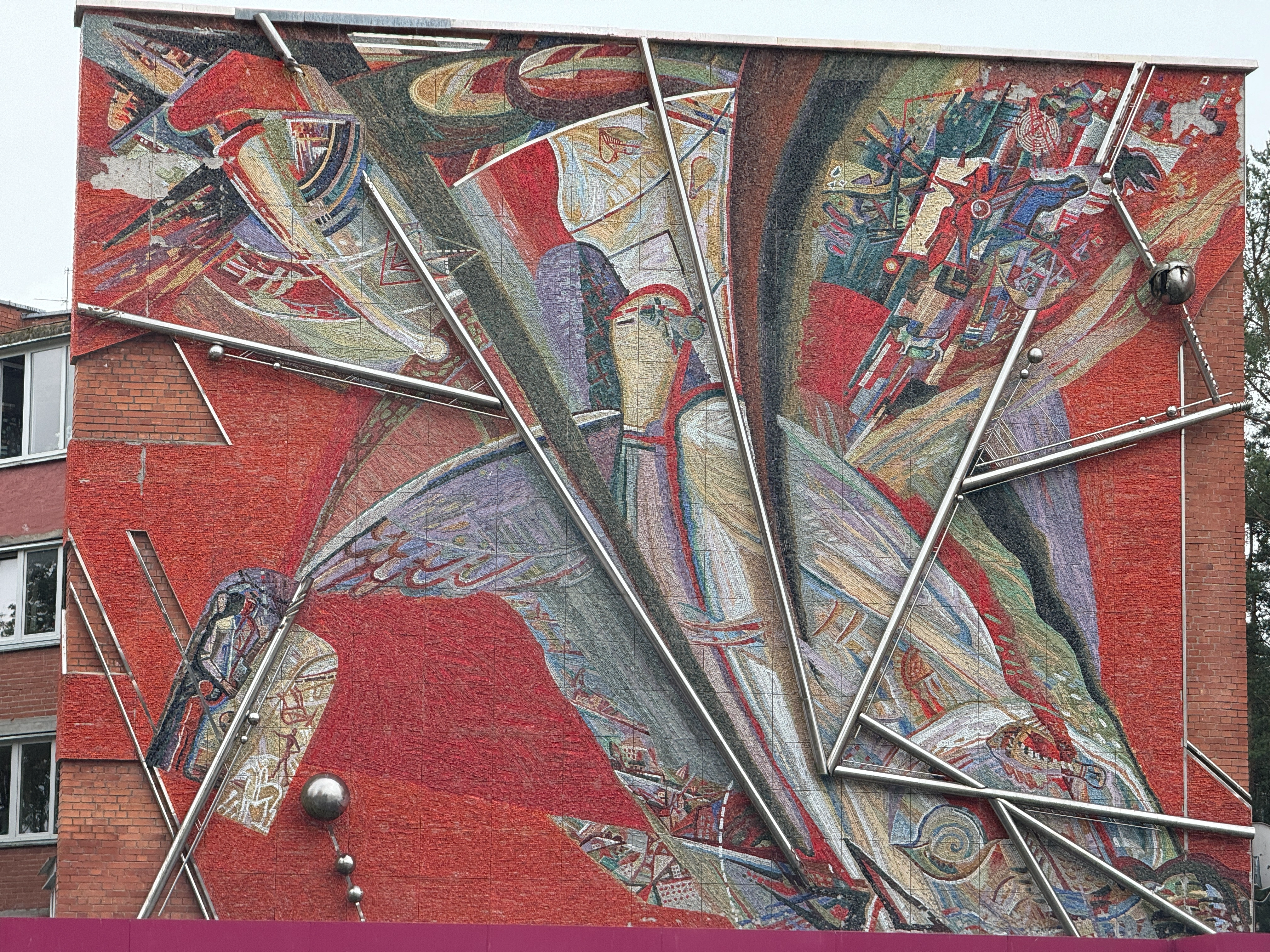
The monumental mosaic Man and the Elements in Visaginas was created by Ukrainian-born artist Viktor Tatarenko. Commissioned by the Ignalina Nuclear Power Plant in 1987, the 154-square-meter artwork took three years to complete and was finalized in 1990. It is made of highly durable smalt glass, sourced from St. Petersburg, Kyiv and Rostov with pieces as small as 0.5 centimeters, and stainless steel structures manufactured directly at the Ignalina NPP. The composition depicts the evolution of humanity from cave paintings to the harnessing of the atom. At the center is an Icarus of the future reaching for space, carrying the four elements: fire, earth, water and air. The dominant red background matches the surrounding brick buildings and symbolizes energy, triumph and human joy.
The mosaic carries a profound warning inspired by the 1986 Chernobyl disaster. Among the thirteen metal spheres integrated into the artwork, the thirteenth is deliberately cracked open from the inside. This symbolizes the peaceful atom breaking apart, serving as a reminder that human error in controlling the forces of nature can be catastrophic.
Today, the mosaic is widely recognized as one of the most important cultural landmarks in Visaginas. Despite the collapse of the USSR causing funding and logistical issues during its installation, the artwork was successfully mounted and remains in excellent condition on the facade of a residential building. As one of the few surviving monumental testimonies to the city's original nuclear identity, it serves as a rare and aesthetically impressive piece of late-Soviet monumental art.
The mosaic is located on the side wall of a residential building in the center of Visaginas, directly above a Vynoteka liquor store. As it faces a public area, the artwork is freely accessible and can be viewed at any time from the street.